
Shop Air Coolers: Refreshment Without Central AC
Summary
Air coolers are a practical solution when you want more refreshment in specific areas on warm days without installing a permanent air-conditioning system. This category includes compact models for bedrooms, home offices, desks, and small living spaces.
- Flexible cooling without permanent installation
- Ideal for small rooms, workspaces, and sleeping areas
- A compact alternative to a fan or large air-conditioning unit
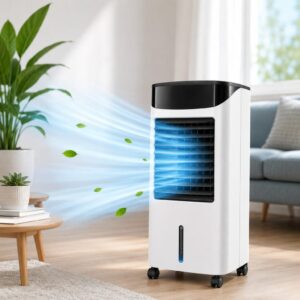
Air coolers for noticeable refreshment without a permanently installed air conditioner
Air coolers are a practical solution when you want more refreshment in specific areas on warm days but do not want to install a permanent air-conditioning system. They are especially suitable for a desk, bedroom, home office, small living area, or the space directly around a sofa. Many models combine airflow with water, evaporative cooling, multiple settings, and straightforward controls.
Realistic expectations are important: an air cooler is not a full air-conditioning unit with an exhaust hose or split-system technology. It does not lower room temperature as precisely as an air conditioner. In return, it is usually more compact, flexible, quick to set up, and often more pleasant than a basic fan when you want a cooler stream of air nearby.
What is a water-based air cooler?
A water-based air cooler uses the principle of evaporative cooling. Air is directed through or past moistened elements. The outgoing air can feel fresher because water evaporates and the airflow feels cooler. At the same time, indoor humidity may rise slightly.
This can be especially pleasant in warm, dry air. In very humid rooms, an air cooler should be used more carefully and the room should be ventilated regularly. Anyone expecting a continuously and precisely controlled room temperature should consider an air conditioner instead. Anyone looking for flexible refreshment directly at a workstation, beside the bed, or in a living area can find suitable models in this category.
Who can benefit from an air cooler?
An air cooler is particularly useful when you want a simple, portable solution for hot days. These devices fit well in rental homes, small rooms, home-office workspaces, bedrooms, or areas where permanent installation is not desired. A compact air cooler can also be the more convenient option if you do not want to move a heavy portable air conditioner.
This category includes different approaches: AiraBreeze uses evaporative cooling, several intensity settings, and a portable design. BreezaMax, BrizaAC, BrizaChill, and PolarBreeze are primarily intended for flexible cooling in individual areas. EpiCooler expands the selection as a model designed to provide greater control over personal comfort in smaller rooms.
Air cooler, fan, or air conditioner?
A fan moves air and thereby creates a cooler sensation on the skin, but it does not actively reduce room temperature. An air cooler goes one step further by combining airflow with water or a cooling function, which can make the air feel fresher. An air conditioner provides substantially stronger technical cooling, but generally requires more energy, space, an exhaust route, or permanent installation.
For many everyday situations, an air cooler is the middle ground. It is useful when you do not want construction work, do not have an exhaust solution, and mainly want to make your immediate surroundings more comfortable. For very large, heavily heated, or continuously hot rooms, a true air conditioner remains the more powerful solution.
What should you consider before buying?
When choosing an air cooler, the main factors are room size, location, noise, controls, water-tank capacity, operating time, intensity settings, and placement. Quiet operation is often more important than maximum output for a desk or bedroom. In a living area, flexible positioning or a remote control may be more convenient.
Also consider whether you want a dedicated air cooler, a fan with a cooling feature, or a combination device. Models with a water tank should be cleaned regularly. This makes use more pleasant and prevents standing water from becoming a problem. For bedroom use, it is also important that lights, sound, and airflow fit your personal routine.
Typical advantages of air coolers
- Flexible use: Many air coolers can be positioned wherever refreshment is currently needed.
- No permanent installation: This is especially practical for rental homes, home offices, and small rooms.
- Pleasant airflow: The airflow can feel fresher than that of a basic fan.
- Compact design: Many devices can stand on the floor, on a table, or beside the bed.
- Practical everyday features: Multiple settings, a timer, remote control, or wall mounting can make operation easier.
Assess possible limitations realistically
Air coolers are intended for localized refreshment. They do not replace a permanently installed air conditioner and usually do not cool large rooms evenly. Their effect depends greatly on room size, humidity, temperature, water level, and placement.
Water-based air coolers in particular should not run continuously in poorly ventilated or already humid rooms. As humidity rises, the cooling effect may feel weaker. Proper use is therefore important: operate the device as needed, keep the water tank clean, and ventilate the room when appropriate.
Our assessment of this category
The editorial team views air coolers as practical summer products for direct refreshment, flexible use, and uncomplicated comfort. This category focuses not on heavy air-conditioning systems, but on compact devices for individual rooms and personal cooling zones.
If you want to work, sleep, or relax more comfortably on hot days, it is worth comparing the models in this category. Before buying, decide which functions truly matter to you: quiet operation, water-based cooling, multiple settings, a remote control, wall mounting, portable design, or an additional heating function.
Frequently asked questions about air coolers
What is the difference between an air cooler and an air conditioner?
An air cooler primarily provides a fresher stream of air in the immediate area. An air conditioner cools room air more powerfully and precisely through a technical refrigeration process. It generally requires more energy, an exhaust route, or permanent installation.
How does a water-based air cooler work?
A water-based air cooler uses evaporative cooling. Air is directed over or through moistened elements, which can make the outgoing airflow feel fresher. Indoor humidity may rise at the same time.
Is an air cooler better than a fan?
That depends on the intended use. A fan only moves air. Depending on the model, an air cooler combines airflow with water, a cooling function, or additional comfort features. For localized refreshment, an air cooler may feel more pleasant.
Which rooms are suitable for air coolers?
Air coolers are primarily suitable for individual areas, small rooms, desks, bedrooms, home offices, sofa areas, or small apartments. Expectations for cooling performance should remain realistic in large rooms or entire homes.
Does an air cooler need to be cleaned?
Yes. Regular cleaning is especially important for air coolers with a water tank. Water should not remain in the unit unnecessarily. The tank, filters, or cooling media should be maintained according to the manufacturer’s instructions.
Which air cooler is right for me?
Compact, quiet models are appealing for a desk or bedroom. For flexible use, a remote control, several settings, and easy placement may matter more. A combination device can be useful if you also want a heating function.
Conclusion: Air coolers are ideal for flexible summer refreshment
Air coolers are a good choice when you want more refreshment on warm days quickly, flexibly, and without permanent installation. They are especially suitable for personal cooling zones, small rooms, and everyday situations in which a basic fan does not provide enough comfort.
Compare the air coolers in this category and choose the model that best fits your room, usage habits, and desired level of comfort.